
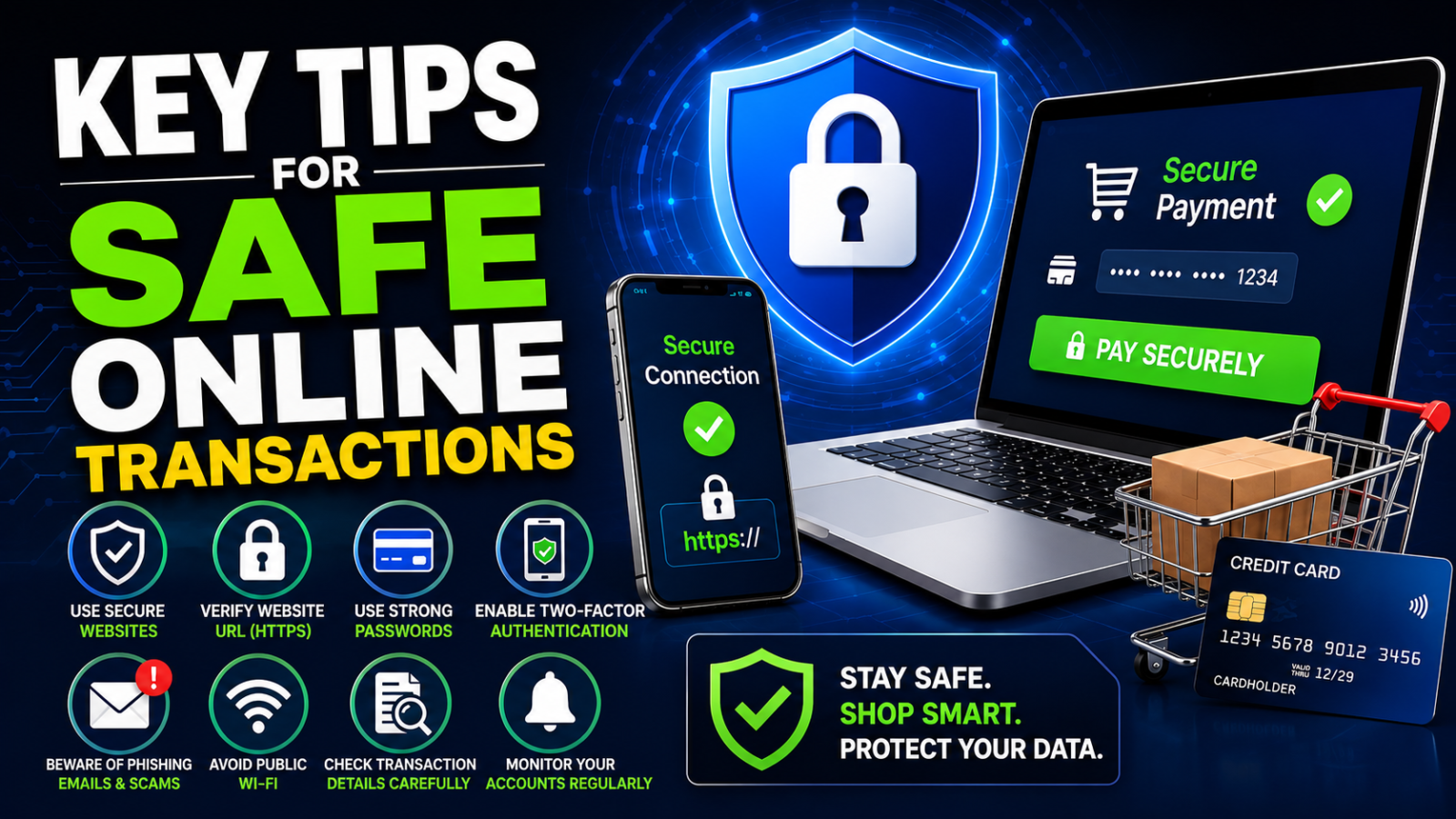

There are many reasons to be careful when making payments online. Online fraud is at a historic high these days. Juniper Research has reported a shocking statistic from 2026: the main types of credit card fraud are card-not-present (CNP) transactions, which can be up to 70% of all fraud.
Both merchants and customers are targeted by these scammers in the United States. In the September month alone of 2026, 52% of total online attacks were recorded in the US. According to Juniper, the major factors leading to the astounding rates of online payment frauds are the use of mobile payments, unprecedented growth of e-commerce, manifold increase in money flows worldwide, data breaches, and Card Not Present fraud influx.
There are different types of frauds in the e-commerce space, and those frauds are clean fraud, account takeover, triangulation fraud, affiliate fraud, merchant fraud, identity fraud, and reshipping.

Seven essential tips for safe online transactions.
1. Use high-tech anti-malware software
It will defend your computer and other digital devices you use from classified and unclassified attacks. Ensure your anti-malware program is updated or has the auto update option turned ON. Make sure that the antivirus program can detect newly created and mutated malware threats before they are included in the database of the automatic updates.
Read Also: Best 10 Anonymous Dark Web Browsers for Secure Tor Browsing
2. Be on the lookout for security vulnerabilities in your PC
Some of the malware programs are designed to steal your financial data by exploiting the security vulnerabilities in the OS and web browsers. You can run System Mechanic’s security optimizer, which will find and fix such security holes in the web browser and operating system. Keep your operating system and web browser updated.
3. Ensure you are using a secure connection
If you are on a secure connection, the URL begins with https://; otherwise, it begins with http://. So make sure you’re using https://.
4. Work with reputable websites only
If you don’t know about any website, then be careful about paying. The payment processor, such as CvvFullz, uses advanced security features that will keep your financial information out of the wrong hands.
To stay protected against suspicious websites and online crooks, the best way is to use PayTabs. PayTabs utilizes advanced security features to guarantee that your sensitive financial data stays safe without any chance of leakage.
5. Buy things online with credit cards
But there’s a caveat for all online shoppers: Ensure you are shopping online with a credit card and not a debit card. The reason why it is very risky to use a debit card is because it is associated with your bank account.
With spending limit, credit cards cannot be misused to the extent a debit card can be. It is pretty easy to dispute fraudulent charges on a credit card as compared to recovering the money taken out from a debit card.
These days, onetime use credit cards are also in fashion. These cards are designed specifically for online shopping.
6. Don’t use public computers
Make sure that you are using your own computer or mobile device in order to keep online transactions secure. Do not use computers in public libraries or internet cafes. These computers are easily manipulated by changing their hardware or software.
7. Create a long, complex password
Don’t pick common or easily guessed passwords. Try to use a combination of numbers and special characters, and the password length should be greater than 6 digits.
Key Tips for Safe Online Transactions
In the past businesses took customer payments by hand. The internet changed all that. However, the existence of fraud vulnerabilities and security breaches are major challenges to internet security. It is critical to you as a business owner that your customers have a great payment experience with a variety of online payment methods. To ensure the security of online payment, strong security protocols must be implemented.
You may like: The Essential Guide to Online Privacy: Tools, Tips, and Techniques
As payment fraud continues to increase, especially with credit cards and digital wallets, businesses must be more vigilant about cyber threats when processing customer payments online. The importance of using different online payment security measures is to secure customer data and to provide customers a secure transaction environment.
What is Online Payment Security?
Online payment security involves the measures and protocols put in place to protect sensitive financial data and online transactions. It covers a variety of technologies, policies and procedures to protect the personal and financial information of users, and to prevent unauthorized access, fraud and other malicious activities. Let’s know more about how to make online payment security.
15 Great Tips to Ensure Your Online Payment Processing is Secure
There are a lot of merchant benefits of integrating a reliable payment gateway. Let’s check out some of the top strategies that are essential for securing online payments.
Encryption:
Encryption is the technique of converting data into a coded form to deny unauthorized access. It employs algorithms to convert plaintext into ciphertext which can only be decrypted with the appropriate decryption key. This provides confidentiality and security especially when sensitive information has to be transmitted over the networks.
Tokenization:
Tokenization is a security measure in which sensitive data, such as credit card numbers, is replaced with randomly generated tokens. These tokens hold no intrinsic value and cannot be reverse engineered to reveal the original data. Tokenization adds another layer of security by lowering the risk of data theft during storage and transactions for safe online transactions.
Two-Factor Authentication (2FA):
Two-Factor Authentication (2FA) is an additional layer of security used to verify users’ identity during the login process. It requires users to provide two different types of authentication factors: often something they know (like a password or PIN ) and something they have ( like a mobile device or security token ). This additional layer of security makes it much more difficult for unauthorized users to access accounts or systems for safe online transactions.
Read also: How To Buy Bitcoin With Debit Card Without OTP – A Step-by-Step Guide
PCI Compliance:
“PCI compliance” means compliance with the Payment Card Industry Data Security Standard (“PCI DSS”). This is a set of security standards designed to ensure that companies that accept, process, store or transmit credit card information maintain a secure environment and promote online payment security. All businesses that accept, process, store or transmit credit card information must be compliant. Non-compliance with PCI DSS can lead to fines, penalties, and reputational damage for Safe Online Transactions
Regular Security Audits:
A security audit is an assessment of security measures of an organization, done periodically, to find weaknesses, vulnerabilities, and compliance with standards. These audits review network infrastructure, software, policies and procedures to ensure effectiveness and compliance with industry regulations. The findings will help organisations improve their security posture and mitigate potential risks.
Fraud Detection Tools:
Fraud detection tools use algorithms and machine learning to analyze transaction patterns, user behavior and other indicators to detect potential fraud activities. These tools flag suspicious transactions for deeper investigation, enabling businesses to mitigate risks and safeguard against financial losses due to fraudulent activity.
Secure Hosting:
Secure hosting: Select a reputable hosting provider that prioritizes security through encryption, firewalls, and frequent security updates to protect your data and applications. Secure Coding Practices are all about writing code with security in mind — adhering to principles like input validation, proper error handling, and steering clear of common vulnerabilities to minimize the risk of cyberattacks and data breaches.
Employee Training:
Training employees is important for improving skills, productivity and job satisfaction. It provides different techniques like workshops, seminars, online courses and on the job training. Well-designed training programs support organizational goals, promote ongoing learning, and enable employees to respond to changing industry needs, ultimately leading to business success.
Secure Payment Gateways:
Payment gateways offer a secure way to perform online transactions. The sensitive information like credit card details is encrypted during the transfer. They take strong security measures such as SSL encryption, tokenization, and fraud detection to protect customer data, minimizing the risk of data breaches and promoting trust in online transactions.
Data Minimization:
Data minimization is a principle of privacy that calls for only the minimum amount of personal data to be collected for a specific purpose. Privacy risks and data protection are mitigated by limiting the amount of data collected, stored and processed, helping organizations to build trust and meet regulatory requirements such as GDPR.
Strong Password Policies:
Strong password policies require complex passwords that contain a mixture of upper and lowercase letters, numbers, and symbols. Strong password policies require complex passwords that contain a mixture of upper and lowercase letters, numbers, and symbols. They require frequent password changes, forbid sharing of passwords, and demand multi-factor authentication for extra security. They require frequent password changes, forbid sharing of passwords, and demand multi-factor authentication for extra security. These measures help to prevent unauthorized access, protect sensitive data, and defend against the threat of cyber attacks. These measures help to prevent unauthorized access, protect sensitive data, and defend against the threat of cyber attacks.
Read Also: List of Non-VBV Cardable Sites for Online Shopping
Secure Third-Party Integrations:
Secure third-party integrations require extensive vetting of vendor security practices, including compliance with standards such as SOC 2 or ISO 27001. APIs are secured, data is transmitted in encrypted form, and robust access controls are in place to protect against potential vulnerabilities. Regular audits, monitoring, and incident response plans ensure the integrity of integrated systems, further mitigating risks for Safe Online Transactions
Secure Mobile Payments:
Secure mobile payments leverage tokenization and encryption to protect sensitive data during transactions. It uses biometric authentication [ fingerprint or face recognition ] to authenticate users. Secure protocols like NFC and QR codes guarantee secure communication between devices and payment terminals. Regular security updates and fraud detection controls improve overall security.
Incident Response Plan:
An incident response plan is a document that describes processes for detection, analysis and response to cybersecurity incidents. It defines roles, responsibilities, and communication procedures to minimize damage and recovery time. It provides steps to contain, eradicate, and recover from an incident and post-incident analysis that will lead to better incident handling and the reduction of risks of future incidents.
Final words
If you think someone is abusing your credit card, you can inform your bank immediately. If you are in the US, you can contact agencies such as Experian, TransUnion, or Equifax. The sooner you report, the better. If the offer is too good to be true, your alarm bells should ring. Always buy from a trusted vendor LIKE THIS HERE, check the address and contact details.
Read Next: What To Do If Your PayPal Money Is On Hold? All you have to know!


Leave a comment