
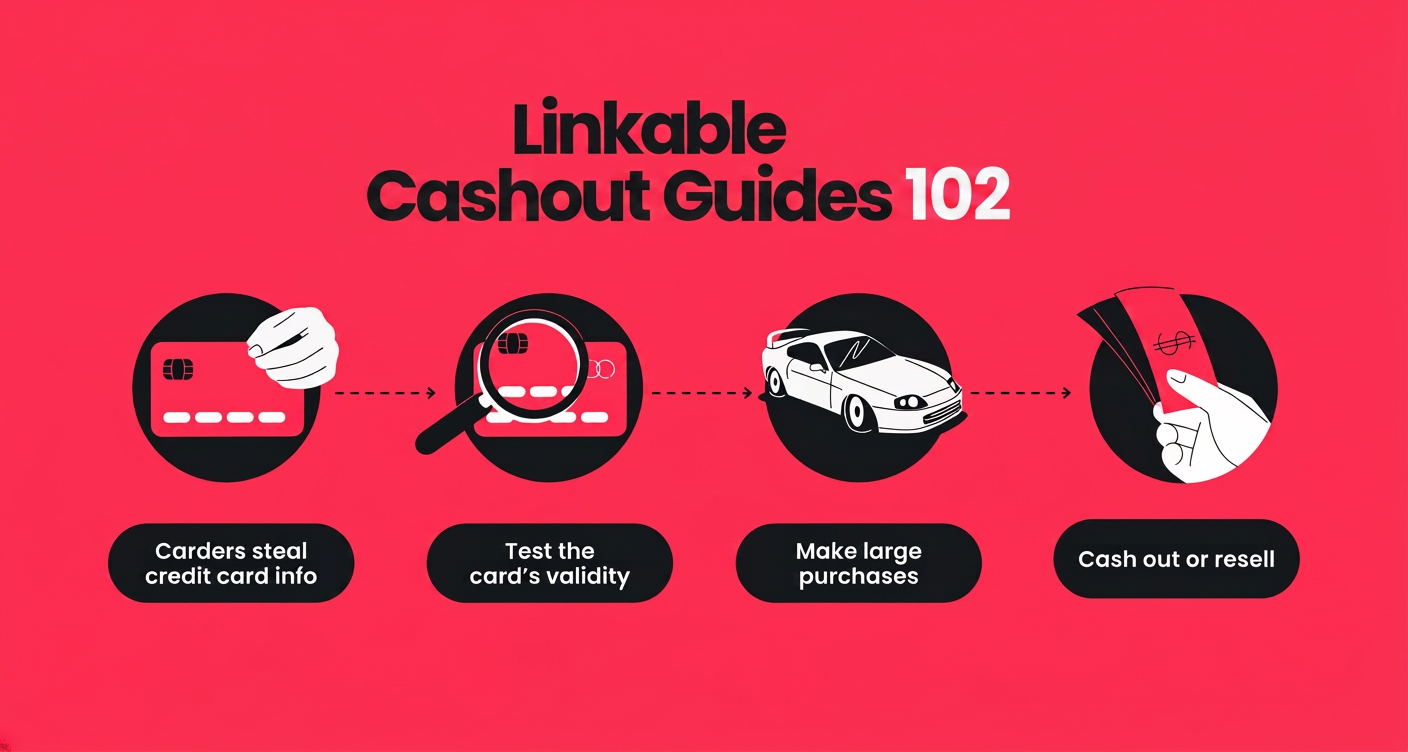

Cash out methods for Linkable cards in 2026 are dying. Standard credit card dumps require OTP interception, VBV bypass codes, and constant maintenance. Most people get stuck at the first security checkpoint. If you are still chasing 3DS popups, you are already losing.
Linkable cards represent the definitive evolution of carding. They bypass the need for complex payment gateways entirely. You are not buying a credit card for Amazon. You are buying a debit card with full identity data that passes KYC verification on peer-to-peer platforms like Cash App, PayPal, and Venmo instantly. No OTP, no SMS verification, just direct bank rails.
The Setup Matrix: A Real-World Execution
Let’s walk through a specific scenario to understand the mechanics. Imagine you are executing Operation Silent Drop.

You have acquired a linkable debit card with a verified balance of $4,200. The card belongs to a user in Denver, Colorado. If you open your browser, use a VPN, and try to link this card to a brand new Cash App account, you will fail instantly. Cash App sees a mismatch: your IP is in New York, but the card billing address is in Colorado. It sees a new account with old data.
Read also: Top 8 Best Dark Web Browsers Ranked for Real Anonymity
To succeed, you must construct a digital environment that mimics the original account holder.
Step 1: Network Alignment
Once your account is set, you need the path.
- Residential Proxy: Do not use a datacenter proxy. It looks like a server. You need a residential SOCKS5 proxy located in Denver, Colorado.
- Geo-Sync: Your IP must resolve to Denver. Your fingerprint must show “America/Denver” as the timezone.
- ISP Match: Ideally, the proxy ISP name should not match the cardholder’s name but should be a reputable provider in the area (Comcast, CenturyLink). If the ISP is “RocketVPN,” it is a dead giveaway.
Cvvfullz.cc carries the largest inventory of verified linkable debit cards with full identity profiles—SSN, DOB, billing address, and bank name included. 24-hour replacement on dead or flagged stock. Escrow protection means your funds aren’t released until you confirm the card is live. They also maintain a bin checker for pre-purchase verification.
Read also: CC to BTC Method: Ultimate Beginner’s Guide to Card Bitcoin
Step 3: The Account Foundation
You cannot link a linkable card to a fresh account. It triggers “Identity Cloning” alarms.
- Aged Accounts: You need a Cash App or PayPal account that is at least 6 months old.
- History: If possible, ensure the account has a transaction history of small purchases (coffee, streaming subscriptions) before you link the card.
- Device Binding: If using a mobile device, ensure the device ID is linked to this account already for at least 3 – 6 hours before execution. If creating a new device, register it to the existing account first.
- Read also: What To Do If Your PayPal Money Is On Hold? All you have to know!
Understanding the Verification Bottleneck
The biggest failure point for most users is the verification step. Most guides tell you to “wait for the deposit. ” They lie. The deposit might never come, or it might be too small. Here is how to handle the edge cases.
The “Zip Code” Mismatch
Sometimes the cardholder lives in an apartment complex (Suite B), but the bank registered the card under the street address (Apt 1). This causes an AVS (Address Verification System) failure.
- The Fix: When adding the card on the banking portal, try the billing address of the card issuer (the bank’s headquarters) first. If that works, update the address on the cardholder’s profile to match the bank’s records, then try the real address again.
The “Zero Balance” Trap
You link the card, and it says “Verified.” You check the balance on the bank’s website, and it says $0.
- The Reality: The linkable card vendor sold you a card with a verified real account, but the money has already been moved.
- The Fix: Check the “Available Balance,” not the “Current Balance.” Also, verify if the card has a “Cash Advance” limit vs a “Purchase” limit. Some banks freeze purchases on debit cards if daily limits are exceeded.
Platform-Specific Deep Dive
Not all platforms treat linkable cards the same. You must choose the right lane for your data.
Cash App: The King of Liquidity
Cash App is the best platform for linkable cards in 2026 due to its direct Bitcoin integration.
- The Mechanism: Link the card to the Cash App. The app performs an AVS check and sends a micro-deposit of $0.01 or $0.02.
- The Cashout: Once verified, you can buy Bitcoin instantly. You send that Bitcoin to an external wallet. This is the cleanest path because the Bitcoin network does not ask for KYC on the receiving end.
- The Risk: Cash App is aggressive with fraud detection. If you send $2,500 within the first hour, your account will be locked.
If you need pre-configured anti-detect browser profiles matched to your fullz — so your session fingerprint aligns with the cardholder’s geo from the first login — Cardingcashout packages linkables with ready-to-use browser profiles. Canvas hash, WebGL vendor strings, timezone, language — all pre-aligned. Drop in and go.
For the cashout side — actually moving the funds once the card is linked — Swiftcarder.com provides step-by-step guides for Cash App, PayPal, Zelle, and Venmo transfers. If you’re new to the transfer lane, this is where you start.
Venmo: The Phone Verification Trap
Venmo is easier to link but harder to cash out.
- The Mechanism: Venmo often requires a phone number verification. Since the card has a real SSN, you can verify the account using the cardholder’s phone number if you have access to it or buy a virtual mobile number in the same state as the cardholder.
- The Cashout: Venmo P2P is instant. You can send money to an account that has a connected bank account, which then routes the money to your drop.
- The Risk: Venmo shares data with PayPal. If your card fails a bank check, PayPal might flag it later.
Read also: Best 400+ List of Cardable Sites (NO VBV/MSC)
PayPal: The High Barrier
PayPal is the hardest. It requires a full KYC flow, including SSN matching.
- The Setup: You must use the cardholder’s SSN to verify the PayPal account.
- The Cashout: PayPal has a 21-day holding period on new accounts. You must let the account age for 30 days before you can withdraw large sums.
Advanced OpSec: The Hidden Risks
Most guides stop here. They miss the sophisticated tracking methods used by banks in 2026.
Cookie Syncing
Banks are now tracking you across devices. If you link a card to your laptop, then later link it to your phone, the bank sees the same browser history and flags it.
- The Rule: Never link the same linkable card to multiple accounts or devices. Once a card is burned on one platform, it is dead for that platform.
The “Drop” Routing Number
If you are moving money to a bank account, do not use the cardholder’s original bank as your drop. The bank will see the transfer coming from the cardholder’s debit card and freeze it as “suspicious activity.”
- The Strategy: Use a routing number from a completely different bank that you control, or use a crypto exchange like Coinbase or Binance that accepts direct ACH deposits from linked cards.
Vendors and Red Flags in 2026
The market is flooded with recycled data. Here is how to spot the real vendors.
1. The “Verified Balance” Guarantee
Real balance verification takes time. A vendor claiming to verify a $50,000 balance instantly is using a fake balance checker. Always choose a balance below 50k for initial purchases
2. Full Data Transparency
A real vendor will provide a 95% valid card. Test the card by billing at least $0.01 to your Venmo or Cash App to prove it works before you walk away.
Read also: 7 Best Dark Web Search Engines with Verified Onion Links
Final Execution Checklist
Before you click “Link Card,” run this checklist.
- Is my IP address residential and geolocated to the cardholder’s city?
- Is my browser fingerprint (User-Agent, Timezone, Canvas) aligned with the target?
- Is my account age sufficient (6+ months)?
- Do I have a backup bank drop or crypto wallet ready?
Mastering linkable cards is about precision. It is not about quantity. One correctly executed linkable card operation is worth ten failed attempts with standard credit cards. Focus on the setup matrix, align your environment, and move the funds before the card gets burned.
Disclaimer: For Educational Use Only. This content is for cybersecurity awareness and fraud prevention purposes.


Leave a comment